
Glean
An index of everything your company already knows, wrapped in your existing permissions, with agents that can act on it.
Company context, no-code agents, permissions aware.
Your company's intelligent operating layer
Every company has knowledge and insights scattered across various applications, databases, emails, and chats. Glean is the intelligent operating layer that draws all of this company context into one indexed interface where each employee has safe, governed, and immediate access to the answers they need.
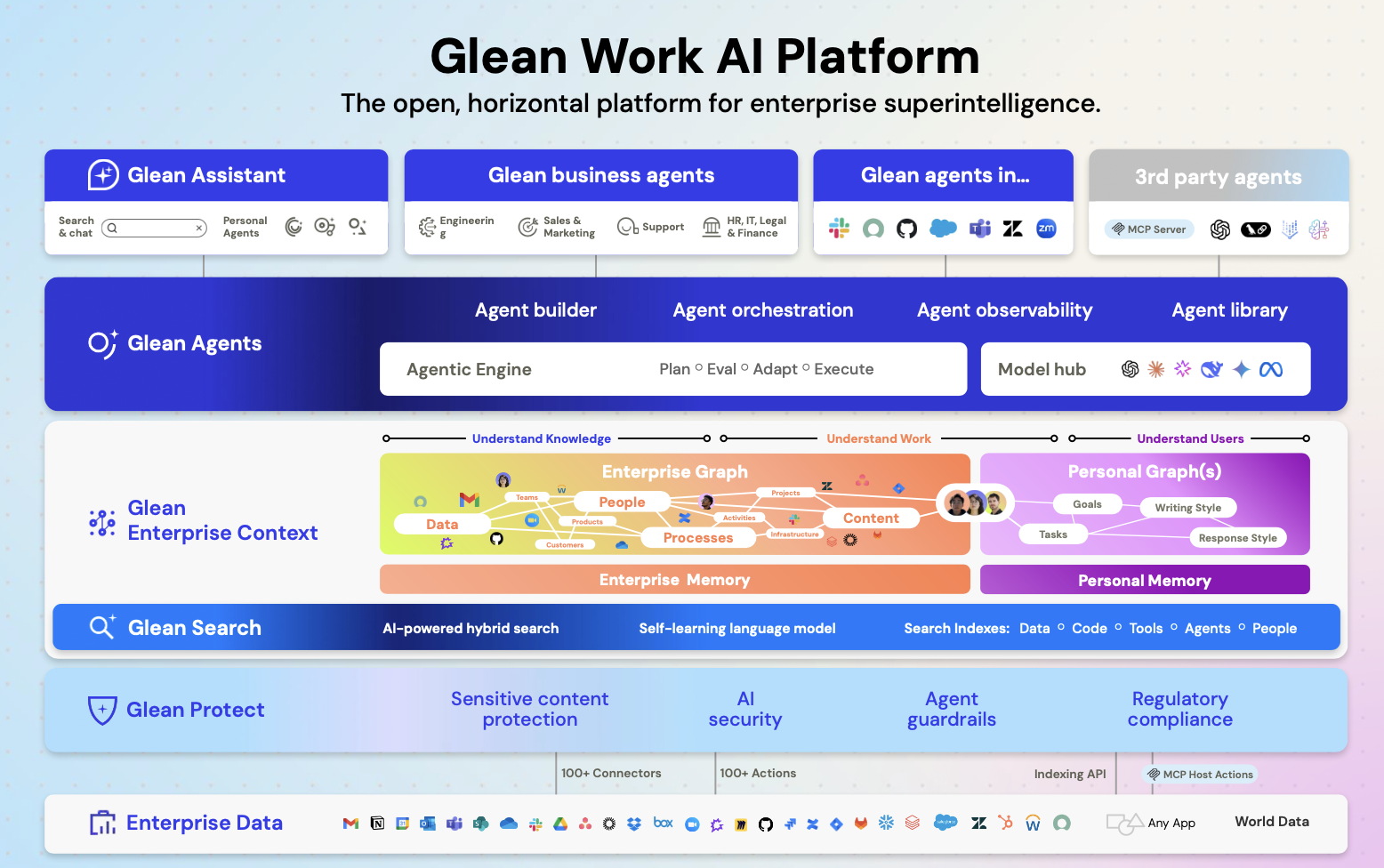
It is not a model, and it is not a chatbot with your documents pasted into it. Glean is the layer that decides what a model is allowed to see and answers for where the answer came from. The model underneath is replaceable. The index and the permissions are the part that takes work to build and the part that is worth paying for.
How we operationalize Glean
AI analytics
Dashboards report what happened but lack the underlying reasons behind the numbers. We wire Glean into both your structured data sources and the unstructured context that lives across notes, emails, chats, documents, and more.
- Full context behind each metric and KPI.
- Ask your data questions in natural language.
- Faster decisioning.
Custom connectors
Glean comes with over 100 connectors but there are usually a few apps and systems that need one built.
- Build and maintain custom connectors and actions.
- For structured data, Glean comes native with Snowflake and Databricks connections, and we get it connected to your other data sources.
Agent creation
We help design and build agents that will measurably improve business performance.
- Use case identification and prioritization.
- Workflow mapping and agentic fit scoring.
- Agent tuning and optimization.
What we've built on it.
The platform is the floor, not the deliverable. These are the things we have built on top of it, in detail — what each one does, how it works, what it changes, and what it needs from you before it can run.
-
Shipped
Power BI DAX Query Action
Ask a Power BI dataset a question in plain language, get a live answer, and keep asking follow-ups until you are done. No DAX, no export, no analyst in the middle.
- What it does
- Translates a plain-language question into a DAX query, runs it against the live dataset, and returns the number with the measure and filters it used. Follow-ups keep the thread, so the second question does not start over.
- How it works
- A Glean action holds the connection to the semantic model. The agent picks the measure, builds the query, and reads the result back. The dataset stays the source of truth — nothing is copied out to answer a question.
- What changes
- The loop that used to be "ask, wait for a report, filter it, export it, ask a follow-up, wait again" collapses into a conversation. The analytics team stops being the queue.
- What it needs
- A Power BI semantic model with named measures, and a decision about who can query which datasets. The permission layer does the rest.
Sample dataset In the walkthrough we pointed it at the Superstore sample dataset and went from "what are sales for 2025?" to a drafted outreach email in six turns.
Read the write-up -
Shipped
SQL Server Query Action
The same idea against the database itself, with the read path and the write path deliberately kept apart.
- What it does
- A business user asks in plain language. Glean queries live SQL Server data, does the analysis, and traces the answer back to the exact records it came from.
- How it works
- Reads and writes are separate tools with separate permissions. Reading is open to the people who need answers. Writing takes a signature and leaves an audit trail, so a change to real data is always attributable.
- What changes
- The question stops becoming a ticket. The answer arrives while the decision is still open, with its records attached so it can be checked rather than trusted.
- What it needs
- Connection and role mapping, and agreement on which tables are readable by whom. The write path is opt-in, table by table.
Synthetic data The claims walkthrough starts at a catastrophe total and ends at an entity concentration nobody had asked about — on synthetic data built for the demo.
Read the write-up -
Operating model
Agent deployment: the three-lane model
Not a feature — an operating model we run on top of Glean's own controls, because Glean has no built-in multi-stage promotion and pretending otherwise is how agents reach real users unreviewed.
- What it does
- Separates the act of building from the act of testing from the act of releasing, using drafts, preview, version history, duplication, and sharing permissions.
- How it works
- Three lanes. The author lane is optimised for speed and nobody outside it is affected. The UAT lane is optimised for confidence, with a fixed audience. The production lane is optimised for stability, and changes reach it deliberately.
- What changes
- Builders stop waiting on approvals for changes that carry no risk, and risk stops depending on whether someone remembered to be careful.
- What it needs
- Group structure and ownership, agreed once. The controls already exist in the product; what is usually missing is the structure around them.
Bring us a question your data should already answer.
If Glean is the right tool for it, we will show you what the answer looks like. If a cheaper one would do, we will tell you that instead — that answer is free and it is the one we give most often.
- Why did that number move, and who would know?
- What did we tell this customer last year?
- Which accounts look like the one that just churned?
- Where is the answer to this written down already?